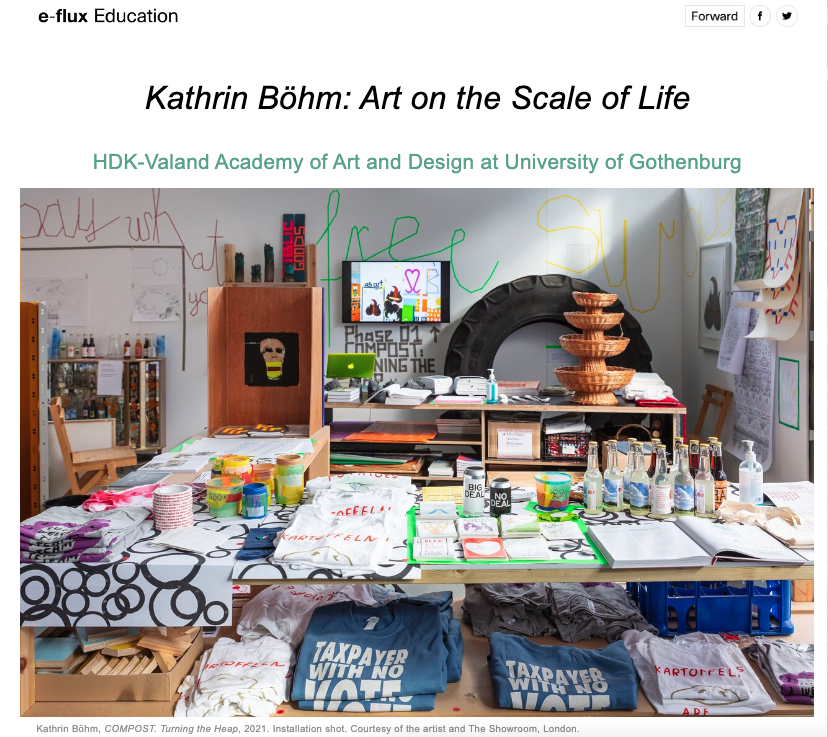
Following the first launch of Kathrin Böhm: Art on the Scale of Life in London last year May, several launches followed (in Helsinki, New York and Barcelona), an now another series has jkicked off. Seeing the e-flux announcement for these new events (in Paris, Rovereto, Berlin, Warsaw, Gothenburg and Utrecht respectively) reminded me of a question posed by an audience member at The Showroom nearly nine months ago. The speaker wondered whether Kathrin – after the lengthy and involved process of composting her practice during the exhibition ‘Compost’ and trying to make a kind of fertiliser for her future practice while producing a catalogue-cum artist’s book–cum-reader – the book finally being there was an endpoint. Initially I left the floor to Kathrin and my co-editors Paul O’Neill and Mick Wilson to answer the question, but then couldn’t resist suggesting that, of course, the book was the outcome of a process about a whole body of work, but at the same time one of a range of articulations within it and therefore could be seen as but one punctuation point in an enduring and generative practice. The new series of launches demonstrates for me precisely the point that I tried to make then.
The book as an object can indeed be perceived as the result of a ‘drawn-out process of turning, sifting, discarding, revisiting, pulling back in, discarding once more, labeling, re-labeling, ordering, re-ordering, giving shape, and reshaping a vast amount of documentary material and critical reflections”, as I described it in my reflection on its production. The outline of the events announced for the coming months show that it can be seen as much more than that: it is also a starting point and part of a range of ongoing enquiries embedded in Kathrin’s expansive way of working with others. Some of the events will platform contributors to Art on the Scale of Life and home in on specific concerns, other gatherings invite people in for workshops that involve making and eating together, while for several the context is more publications oriented. All of which underlines that books can function as more than archival repositories gathering a historical overview of what happened in the past. Once here, they can wholeheartedly remain part of the lives of those whose practices they relate to or come out of, and in revisiting the thinking that produced them with others giving it new and other lives.*
- with thanks to Walter Benjamin’s ideas as articulated in ‘The Task of the Translator’.

 Gerrie van Noord